
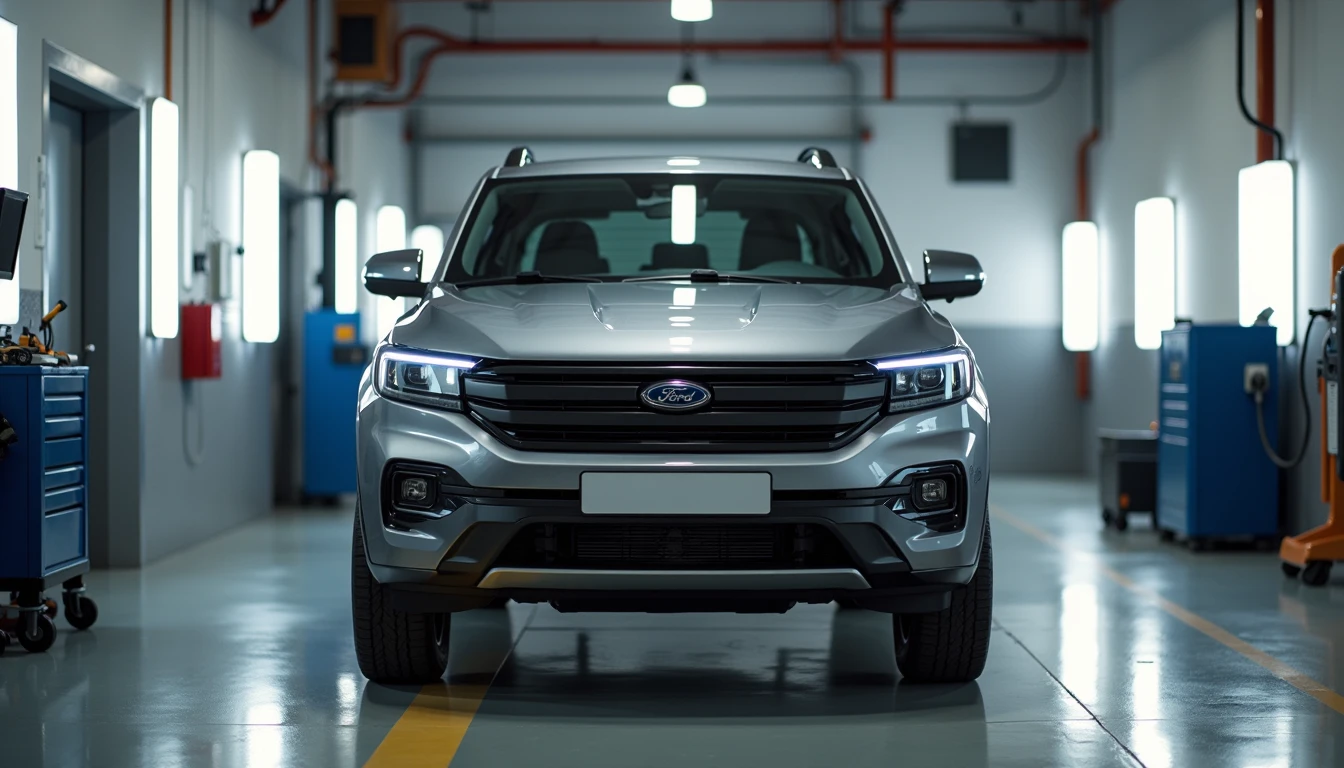
Ford’s next EV bet is a $30,000 midsize pickup on a brand-new platform built in Long Beach
Ford is trying to solve the part of the EV equation that’s been blowing holes in balance sheets: cost. The company says it has developed a new electric vehicle architecture—called the Universal Electric Vehicle (UEV) platform—at its Long Beach, California facility, and the first vehicle off it is slated to be a roughly $30,000 midsize pickup for the U.S. market next year.
A few key details Ford is putting on the table:
- New “Universal Electric Vehicle” (UEV) platform developed at Ford’s Long Beach, California facility
- First UEV product: roughly $30,000 midsize pickup truck for the U.S. market next year
- UEV is positioned as central to getting Ford’s Model e EV business to breakeven by 2029
- Tech highlights: smaller battery with U.S.-produced lithium iron phosphate cells, plus a 48-volt electrical architecture
That’s the headline inside the headline: Ford isn’t talking about another halo truck or a niche crossover. It’s pitching a price point—and doing it while “much of the industry pulls back,” as the report frames it. For Ford’s EV strategy, a $30,000 pickup isn’t just a product. It’s a stress test.
The platform matters because Ford needs it to. The company has been candid that its Model e EV unit has been racking up billions of dollars in annual losses, and the UEV is described as critical to flipping that math to breakeven by 2029. Ford has also said its future EVs will be profitable within a year of launching—an aggressive claim in a segment where timelines have a habit of slipping and margins have a habit of evaporating.
What Ford wants this truck to be: cheap, different, and (allegedly) alone
Ford’s EV product leader Alan Clarke, speaking to CNBC at the Electric Vehicle Development Center in Long Beach, didn’t mince words about where this pickup is supposed to sit: “The midsize pickup truck, there won’t be anything that competes with it, either in price or product form, and so I think it sort of stands alone in that sense.”
That’s a big statement with zero room for error, and Ford knows it. The company isn’t just promising a low number on a window sticker; it’s suggesting there’s a product gap that competitors haven’t filled at that price. Importantly, Clarke’s quote is about price and “product form,” not power, range, towing, or 0–60 bragging rights. Ford isn’t trying to win the internet spec-sheet Olympics here. It’s trying to get EVs down to “the prices that American consumers are willing to pay,” as Clarke put it.
Clarke is also not a random talking head. The report notes he spent 12½ years at Tesla and was recently promoted from senior director to vice president of Advanced Development Projects. If Ford’s looking to build an internal “startup inside the legacy automaker” vibe, that resume is doing a lot of the lifting.
His other message is basically the motto of every EV team that’s lived through the last couple years: “Agility is key.” Clarke said Ford has been able to “pivot around all the different market conditions,” acknowledging “massive headwinds” that forced adjustments. Translation: the market changed, the money got tighter, and the easy growth assumptions got torched. Now everybody’s re-learning how to build vehicles people will buy without subsidizing every unit.
The cost play: smaller LFP battery, 48-volt architecture, and chasing gas-car economics
Ford’s stated goal for these UEV-based vehicles is straightforward: comparable costs to gas-powered vehicles, achieved through “new technologies and efficiencies.”
Two specifics called out in the report:
- A smaller battery pack using new, U.S.-produced lithium iron phosphate (LFP) cells
- A 48-volt electrical architecture that improves efficiency and lowers weight
None of this is marketing fluff; it’s the kind of unglamorous engineering that decides whether an EV program survives. LFP chemistry is generally associated with durability and cost advantages versus other lithium-ion chemistries, and Ford is explicitly linking it to a “smaller battery pack,” which is another way of saying the platform is being designed to avoid the industry’s bad habit of brute-forcing range with expensive, heavy capacity.
The 48-volt architecture mention is also telling. Ford is emphasizing efficiency and weight reduction—again, not peak horsepower or some camera-heavy “tech experience.” If you’re trying to hit a roughly $30,000 target on a pickup, you don’t get there by adding complexity. You get there by deleting it, simplifying it, or making it cheaper.
Ford is essentially saying: we’ve got to build EVs like we build mainstream gas vehicles—at mainstream costs—because the market has made it clear it won’t endlessly pay extra just because the drivetrain is electric.
The China problem, stated out loud
Clarke also addressed the competitive benchmark everybody in Detroit is watching: China. He said he remains “pretty confident” UEV can be competitive against Chinese vehicles, while adding that Chinese companies operate under “different rules,” citing government support and lower labor costs.
That’s not a throwaway line. It’s the crux of the next decade for mass-market EVs: can U.S. and legacy Western automakers build compelling EVs at prices normal people will actually pay—without relying on incentives to prop up demand and without losing their shirts on every unit?
Clarke’s answer is blunt: “We only win with speed, and we have to play by the rules here.” And, crucially, he tied competitiveness directly to price discipline: Ford “won’t win” unless it gets to price points American consumers accept for EVs “like this.”
If Ford can truly deliver a roughly $30,000 midsize EV pickup next year—and do it on a platform designed for gas-car-like costs—that’s not just a new model. It’s a signal that Ford thinks it’s found a repeatable recipe, not a one-off science project.
The larger bet is that UEV becomes the backbone of Ford’s next generation of EVs, with additional vehicles to follow the pickup. Ford’s bigger goal is spelled out right in the report: use this platform to help drag Model e from billion-dollar annual losses to breakeven by 2029, while claiming future EVs can turn profitable within a year of launch.
Ambitious? Yes. Necessary? Also yes. The industry doesn’t need more EV concepts. It needs EVs that pencil out.