Traveling through Banff with Indigenous guides offers a deeper understanding of the land, its history, and living traditions—revealing stories often missed by conventional tourism.
The beauty of the Canadian Rockies permeates everywhere you turn in Banff. In October, after the rush of summer visitors has passed and the town anticipates the snow season, the snow-dusted mountain ridges rise above the relatively mild temperatures on ground level and are visible everywhere you turn.
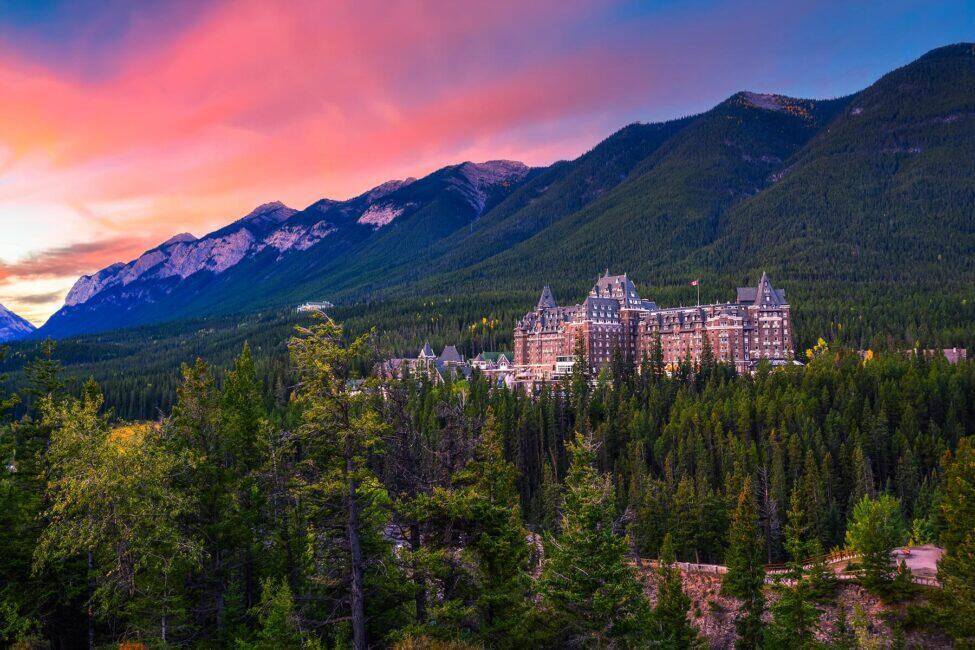
Established in 1885, Banff National Park is Canada’s first national park. The construction of the Canadian Pacific Railway across Canada, as well as the encounter of sulphurous hot springs near the present-day town of Banff, motivated the establishment of the park and the rush of wellness tourism that followed. The châteauesque Banff Springs Hotel—later rebranded as Fairmont Banff Springs Hotel—was built near the confluence of Bow and Spray Rivers, attracting wealthy travelers from across the continent.
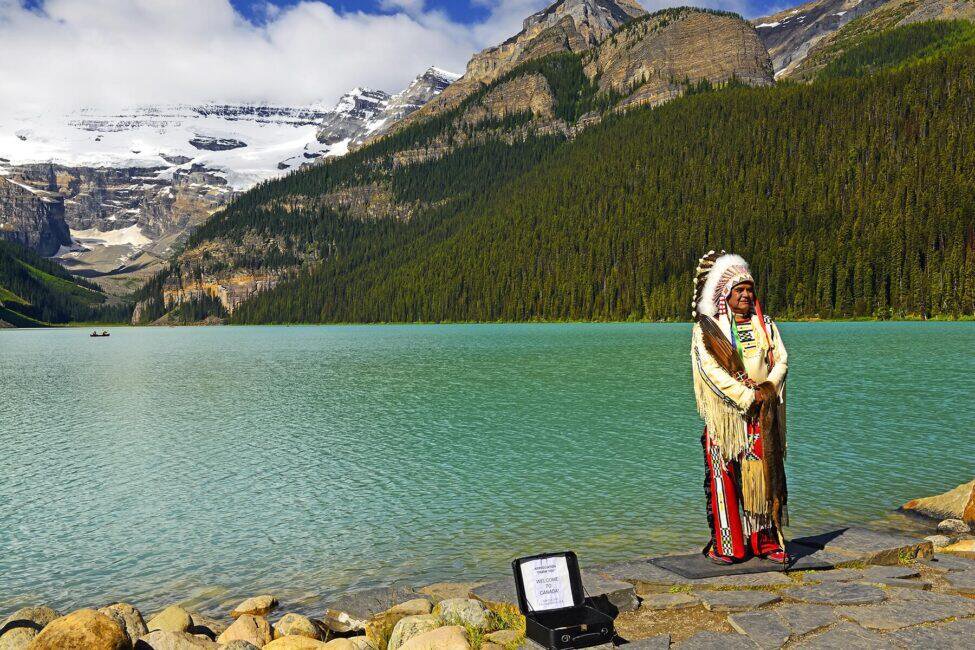
But before Banff was Banff, the area was Mînî hrpa, or “Mountain Where The Water Falls,” for the Stoney Nakoda peoples who lived in the area for thousands of years. In his landmark book, These mountains are our sacred places: the story of the Stoney Indians, John Snow, the former Chief of the Stoney Nakoda Nation, described a vast and beautiful land rich with resources, through which the people moved and lived freely.
“In the days prior to the coming of the whiteman, we lived a nomadic way of life, hunting, fishing, and gathering from the abundance of this good land,” he wrote. “There were literally millions of buffalo roaming on the western prairies, along the foothills, and even into the Rocky Mountains themselves.”
But the arrival of the Europeans in North America changed the landscape of the Rockies forever, as well as the livelihoods of those occupying them. The Stoney Nakoda guided the first European visitors through the region and engaged in trade; but the subsequent history of colonialism, displacement, and abuse pushed the Stoney people to the fringes of their own land. By the late 19th century, the population of buffalo—or more accurately, the American bison—became decimated by colonial expansion, overhunting, disease, and the introduction of domesticated European animals. The consequent ban on buffalo hunting was a critical blow to the livelihoods of many First Nations that relied on the game for sustenance.
Seeking to understand the layered beauty of Banff with the help of local Indigenous people is a timeworn practice that traces its roots to colonial times. Europeans repeatedly sought the help of local Indigenous people to understand and navigate the new landscape. As Travis Rider, a Knowledge Keeper of the Stoney Nakoda, put it, his people were “born into” tourism: “When your nation is a pioneer—pioneers to tourism, then the members of your nation know how to work with the people that are coming in,” he said. “When your people are exposed to tourism for hundreds of years, then you adapt.”
Despite the historical abuses born from this relationship, seeking the knowledge of Indigenous guides today bears a new meaning, if approached in good faith: an invaluable opportunity to learn and connect with the ancestral knowledge of the land we occupy.
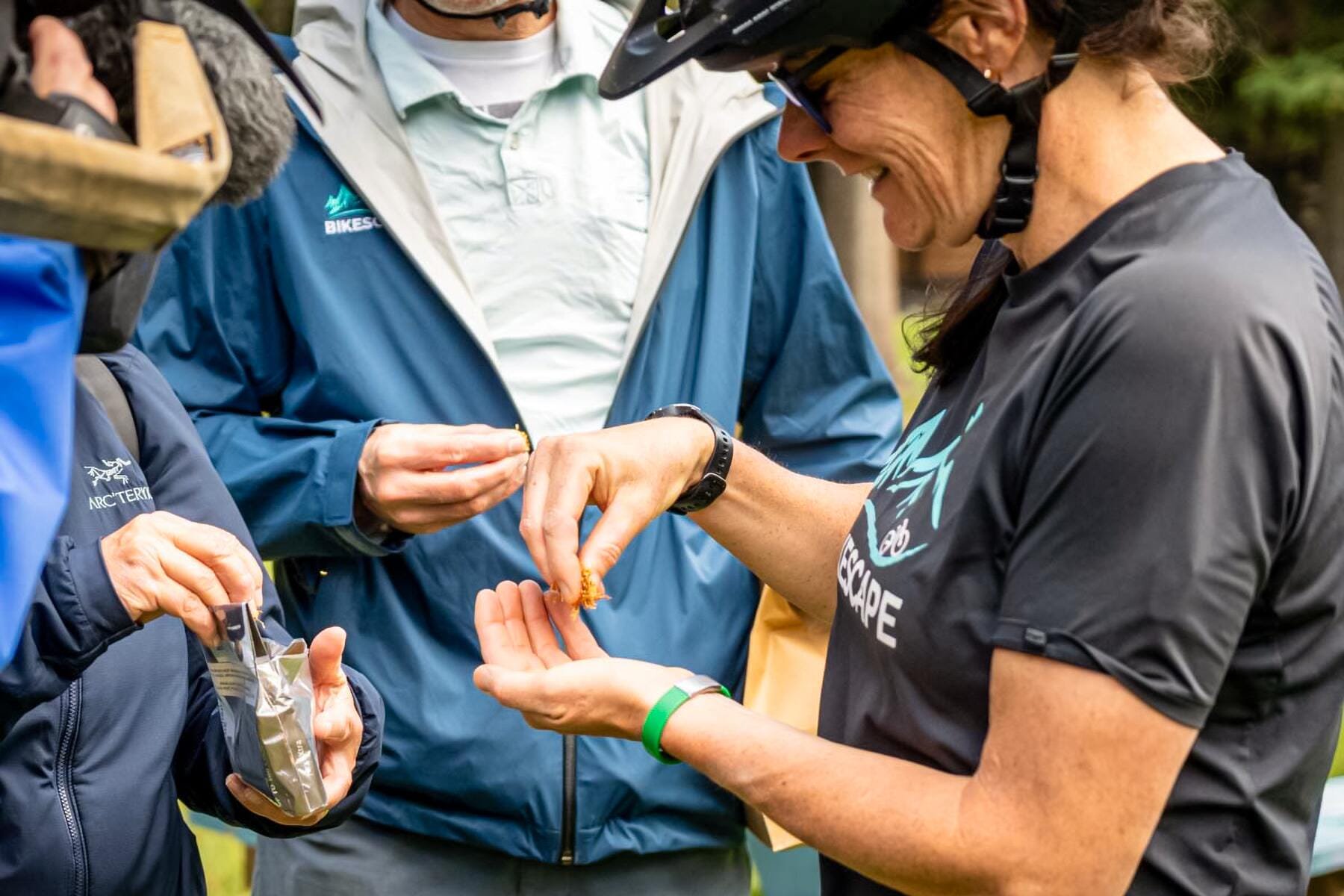
Traditional ceremonies of the Indigenous people are not easily accessible to outsiders. Participating in a tour led by an Indigenous person is a way to witness and participate in them. In a bike tour led by Clare McCann of Bikescape and Heather Black of Buffalo Stone Woman, I was given, for the first time in my life, a sprinkle of tobacco to offer the land. Tobacco was and is continuously used as an offering for communication, connection, and gratitude: One might offer tobacco to ask for advice from an elder; before beginning an important project or reaching a milestone; or to simply express gratitude for the sheer magnanimity of Earth. The fact that she was still here, allowing us to live our lives on her riches, was something to be grateful for.
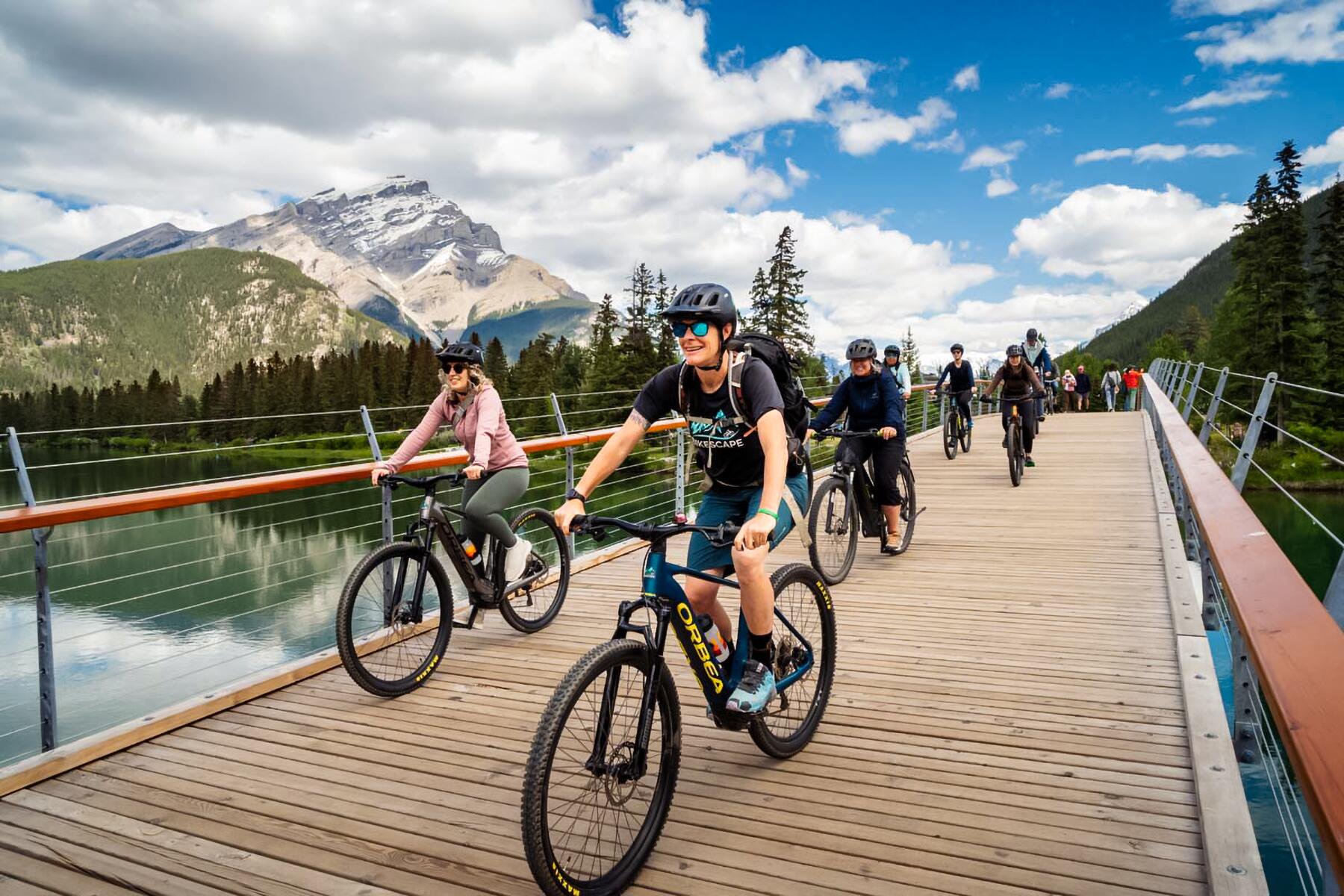
After the tobacco offering, we threaded the town of Banff and the Bow River on electric bikes, which can be thrilling even on relatively well-paved paths because of the crisp air and the omnipresent mountain scenery. Near the Bow River, we parked our bikes, and I learned about smudging: a ceremony that cleanses the body and spirit. Foraged cedar, sweet pine, sage, and sweet grass were combined into a miniature cast-iron pan and burned to produce smoke. Heather swept the smoke into her eyes, nose, and mouth and offered prayers to see good things, speak good things, and to act against injustice. Then it was my turn: In Korean culture, which I am a part of, connecting with our ancestors is a culturally significant practice. Heather encouraged me to do just that, while I swept the smoke towards my body.
Museum-going is a worthwhile way to spend an afternoon or two in the downtown area. The Buffalo Nations Luxton Museum, which highlights the Indigenous cultures of the Rocky Mountains and the Northern Plains, can feel dated in its initial presentation—think dioramas of Indigenous people and taxidermied animals—but its collection of artefacts is genuine and wide-ranging. In addition to objects like traditional beaded jewelry, you can also find fringed guncoats and navel cord amulets used to hold a baby’s navel cord.
Travis Rider, who guided me through the museum, pointed out photographs of his extended family and offered a wealth of knowledge about everything we saw: how feathers were acquired and given for headdresses, the exchange rate of 200 beaver pelts for a single machine gun (we agreed that that seemed like an unfair trade), and everything in between.
As we examined the clothes displayed throughout the museum, Travis pointed out the use of both traditional materials used prior to European contact, as well as contemporary materials introduced by the Europeans. For example, elk teeth threaded onto a shirt was traditional, while ribbons draped around a skirt were contemporary. “I think that’s very important to remember—our ancestors knew how to survive in their world at that point in time,” he said. “It’s always a balancing act between preservation and evolving.”
About a ten-minute drive from the town of Banff are the Cascade Ponds, a glorious, scenic refuge with vistas of Cascade Mountain, Mount Rundle, and Sulphur Mountain. It is also an excellent place to observe the Sleeping Buffalo, commonly known as Tunnel Mountain, whose summit offers a panoramic view of the winding valley below. Smaller than other mountain peaks, it presides over the surrounding area in a form that is reminiscent of a buffalo at rest. I met Jordan Ede, a member of the Cree Nation who also leads tours for Mahikan Trails, here for a walking tour.
“[S]leeping buffalo was seen as a guardian spirit that would protect the land, and the medicines, and the people while they were in the area,” Jordan said. He told me that, in 2016, 15 different Indigenous nations, including the Stoney Nakoda and the Blackfoot, petitioned to officially rename it as Sacred Buffalo Guardian Mountain. The petition is ongoing.
After over a century of absence in the park, wild bison were reintroduced to Banff in 2017. By 2024, the number grew to over 130. In 2024, members of several First Nations took part in a ceremonial harvesting of bison for the first time since the park’s inception, and it was an emotional experience for many.
On the bedrock of this history, it is worthwhile to taste a bison dish in Banff. Almost every restaurant in town offers its own version of the meat, including the relatively secluded Juniper Bistro and Three Bears Brewery & Restaurant, but the most refined version can be found at the Bison Restaurant, where it’s served with a delectable foundation of ricotta cavatelli that cuts through the fattiness of the meat.
As Jordan and I walked through the ponds, he pointed out the plants of the landscape and their traditional uses by the Indigenous peoples: wolf willows, which grow as shrubs with mealy berries and seeds that were used as decorative beads; wild strawberries, whose leaves get rid of excess liquid in the bowels and stop diarrhea; and rose hips, which can be used to produce rose water that helps to heal burns. He told me that, in the Cree language, rose hip translates to “itchy bomb berry”—an example of the language’s descriptive nature. “Something like a mountain or a lake or anything else that’s so much older, larger, and more significant than any one person,” he said, “who has a right to name it, to claim ownership?”
I immediately thought of Mt. Everest, named after George Everest, a British surveyor; then of mountains in the U.S. named after presidents, senators, and military officers. It occurred to me that this kind of naming was an act of taking, whereas descriptive naming had been born out of a need to communicate.
Looping our way back, I watched the late afternoon sun glint across the open valley. It reflected off the ponds in golden flecks and brought the sweeps of dried grass to startling clarity. I imagined a herd of buffalo traveling through this grass and the sublimity of the landscape—both imagined and real—filled me with bliss. I wondered whether those who came before me on this land, thousands of years ago, would’ve felt the same.
The Bow Falls Trail is a well-paved walk around the forest and leads to Bow Falls, a streaming cascade of the river that cuts through its bedrock. It’s practically in the backyard of Fairmont Springs Hotel, which warrants a visit for its castle-like beauty and famed spa, where you can soak your tired body or treat yourself to a massage. The property is a complicated symbol of Banff’s history, but it does make efforts to do its part in the town’s reconciliation with its Indigenous people: Its spa partners with Mother Earth Essentials, a bodycare brand owned by Carrie Armstrong, a descendant of a line of Cree Medicine Women.
The efforts of reconciliation between the Canadian government and the country’s Indigenous peoples are ongoing. Section 35 of the Constitution Act in 1982—which, among other things, recognized the right of its First Nations, Inuit, and Métis people to forage, hunt, and fish for sustenance and ceremony—was a milestone that marked the beginning of the government’s commitment to the process.
Still, reconciliation is a relatively nascent undertaking. The direct and indirect effects of residential schools, where Indigenous children were boarded and abused with the goal of isolating them from their languages, cultures, and religions, are still felt today. The last federally-funded residential school closed in 1997.
There is no one simple solution to generational trauma, and the political, economic, social, and cultural complexities of reconciliation. But while travelers can’t correct the injustices of the land they’re visiting, they can seek out to hear those that were previously unheard, and trust in those who know their land.
As I ambled along the Bow River, I recalled its Blackfoot name, Makhabn, which meant “river where bow reeds grow.” People of several First Nations had used the Douglas Fir trees growing on the banks to craft their bows. I looked down at the thermos full of hot marshmallow root tea that I carried around and applied the same tradition of descriptive naming: tea that soothes my stomach and throat. In this way of seeing, I found greater gratitude for everything I had, and I was happy to have found it in Banff.