
A Cadillac recall applies to your vehicle only if its identification number is included in a specific campaign; the model name alone is not enough. Check your 17-character VIN through the National Highway Traffic Safety Administration (NHTSA) recall lookup or Cadillac’s owner resources, then contact a dealer about the remedy. Recall listings change, and a complete up-to-the-minute list of affected Cadillac vehicles cannot be verified here. A notice may cover a safety defect, but the risk, repair and urgency depend on the campaign.
Start with the VIN, not the headline
A Cadillac recall can cover a particular range of production dates, equipment or components rather than every vehicle with the same badge and model year. A headline about an Escalade, for example, does not establish that your Escalade is affected. Likewise, an owner who never received a letter should not assume there is no open campaign.
Find the VIN at the base of the windshield on the driver’s side, on the driver’s door-jamb label or on your registration. Enter all 17 characters at NHTSA.gov/recalls. Cadillac’s owner website and a Cadillac dealer can also check the vehicle’s status. If you are shopping for a used vehicle, ask the seller for the VIN before making a deposit.
An open result is the starting point, not the whole story. Read the notice for the affected component, the safety risk and any interim precautions. Note the NHTSA campaign number and the manufacturer’s recall number; a dealer can use either to discuss the specific repair. A vehicle may have more than one open campaign, each with a different fix and parts situation.
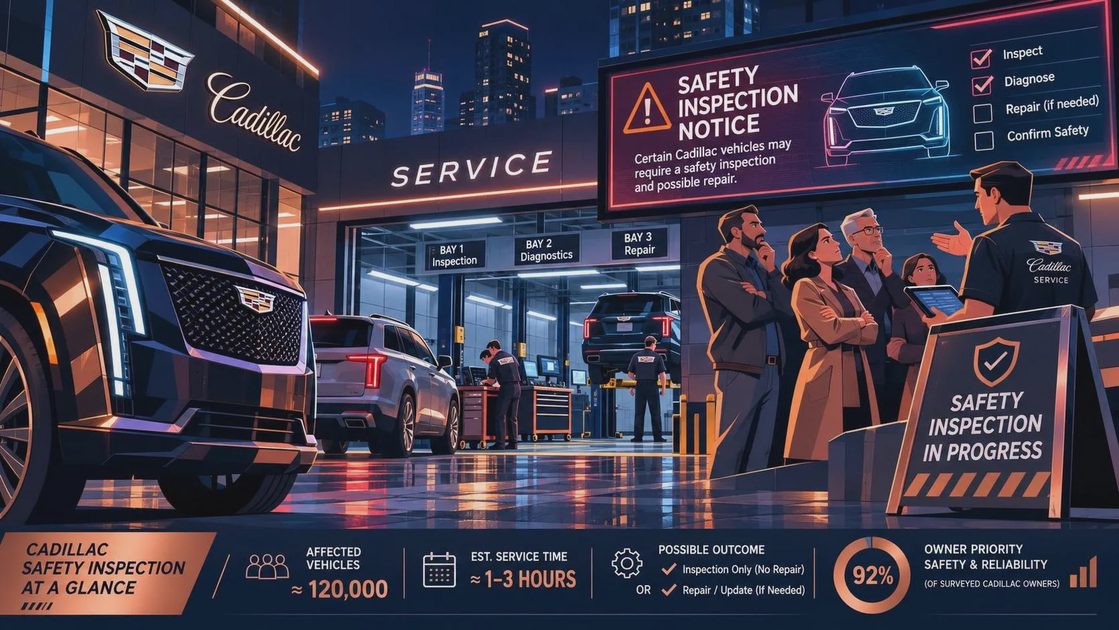
If the lookup shows no open Cadillac recall, that is useful but not a guarantee that the vehicle has never been recalled or will never be recalled. A completed repair may no longer appear as open, and a newly announced campaign may take time to be reflected in individual VIN results. Ask a dealer to check the vehicle’s recall history if you need documentation of work already completed.
Read the notice for risk and remedy
Here’s what we know — and here’s what we don’t: a recall announcement identifies a safety issue and the population covered by that campaign. It does not mean every included vehicle has already experienced a failure. The filing and owner notice should explain the potential consequence, any warning signs and what owners should do while waiting for a repair.
Pay particular attention to instructions that affect driving or parking. If a notice says to stop driving, park outside or avoid a particular activity, follow that campaign-specific direction. Do not substitute a general internet summary for the manufacturer’s instructions. If the vehicle is behaving dangerously, stop using it when safe to do so and contact the dealer or Cadillac for guidance; arrange a tow if driving it would be unsafe.
The remedy may be a software update, inspection, adjustment or replacement part. The right fix is the one specified for that VIN and campaign. Some repairs are available when the recall is announced; others require a second notice once parts or a procedure are ready. An announcement without an available remedy is not the same thing as a completed recall.
A technical service bulletin, or TSB, is different. A TSB gives service personnel information about diagnosing or repairing a condition; it is not automatically a safety recall. Warranty coverage, eligibility and cost can differ, so ask the service department which type of action it is quoting and request the campaign or bulletin number.
Booking a Cadillac recall repair
Call a Cadillac dealer with the VIN and campaign number. Ask whether the final remedy is available, whether parts must be ordered and how long the vehicle is likely to be needed. If there are multiple open recalls, ask whether they can be handled in one visit. Safety recall repairs are generally performed free of charge, subject to applicable rules and campaign eligibility.
Get the appointment and any parts order documented. If the dealer cannot schedule the work promptly, ask for an estimated arrival date and whether another authorized dealer has availability. Availability can vary by location; a recall announcement is not proof that every service bay has a shelf full of parts.
If you previously paid to fix the same problem, keep the invoice, proof of payment and repair details. Ask Cadillac about reimbursement and review the instructions in the owner notice. Reimbursement is not automatic in every circumstance, and eligibility and deadlines depend on the campaign and applicable rules.
Ask for a repair order when the work is finished. It should identify the vehicle and describe the campaign work performed. Retain it with the vehicle records, especially if you plan to sell. Online status may not update immediately, so contact the dealer if an open listing persists after the repair has been reported.
What to do when the lookup and your experience disagree
A VIN lookup is a campaign tool, not a diagnostic scan. If it shows no open recall but the vehicle has a safety-related problem, have the issue inspected. Record the symptoms, when they occur, any warning messages and the dealer’s findings. Avoid guessing at a cause; the useful detail is what the vehicle actually did.
You can report a suspected safety problem to NHTSA through its website. A complaint is not a recall and does not guarantee that an investigation will be opened, but it gives the agency information it can evaluate. Keep copies of repair orders and correspondence if the problem continues.
For an unresolved Cadillac recall repair, escalate from the dealership to Cadillac customer assistance with the VIN, campaign number and a concise timeline. If the remedy is unavailable, ask what interim instructions apply and when the next update is expected. Loaner or transportation assistance should be confirmed rather than assumed; it can depend on the campaign and circumstances.
Finally, make sure your registration and manufacturer contact information are up to date, particularly after buying a used vehicle or moving. Mail notices are important, but checking the VIN yourself is faster than waiting for an envelope. That is the practical dividing line here: a recall headline tells you what to investigate; the VIN and campaign documents tell you what applies.
Travellers Write
No letters yet — be the first traveller to write.