The answer to what is the safest car is not a single badge or a five-star sticker. It is the vehicle that protects occupants in a crash, helps prevent that crash, fits the driver, and performs consistently across real-world conditions. For shoppers, that usually means starting with independent testing from the Insurance Institute for Highway Safety and the National Highway Traffic Safety Administration, then looking closely at equipment, visibility, recalls, and ownership costs.
Safety has also become harder to judge. A $35,000 compact crossover can carry automatic emergency braking, blind-spot monitoring, and adaptive cruise control, while a larger vehicle with a higher price can still have weak headlights or a poor small-overlap result. The press release is not the test sheet. Here is what we know — and here is what we do not.
What makes a car genuinely safe?
When people ask what is the safest car, they often mean the vehicle with the strongest crash-test record. That is important, but it is only one part of the answer. A sound evaluation starts with crashworthiness: how well the passenger compartment holds its shape and how effectively restraints manage forces on the driver and passengers. Front, side, and rollover tests all matter, as do head restraints and seat-belt performance.
Crash avoidance is the second major category. Automatic emergency braking can warn the driver and apply the brakes when a collision with a vehicle or pedestrian is imminent. Lane-departure prevention can help correct an unintended drift. Blind-spot alerts are useful on multilane roads, but they do not replace a shoulder check. Adaptive cruise control reduces workload on a freeway; it does not turn the driver into a passenger.
The third factor is basic vehicle behavior. Good brakes, predictable steering, usable mirrors, strong headlights, and stable handling in rain are not glamorous features, but they matter every day. A driver who can see around a thick roof pillar and confidently place the car in a lane has a practical safety advantage.
The safest cars worth putting on a shopping list
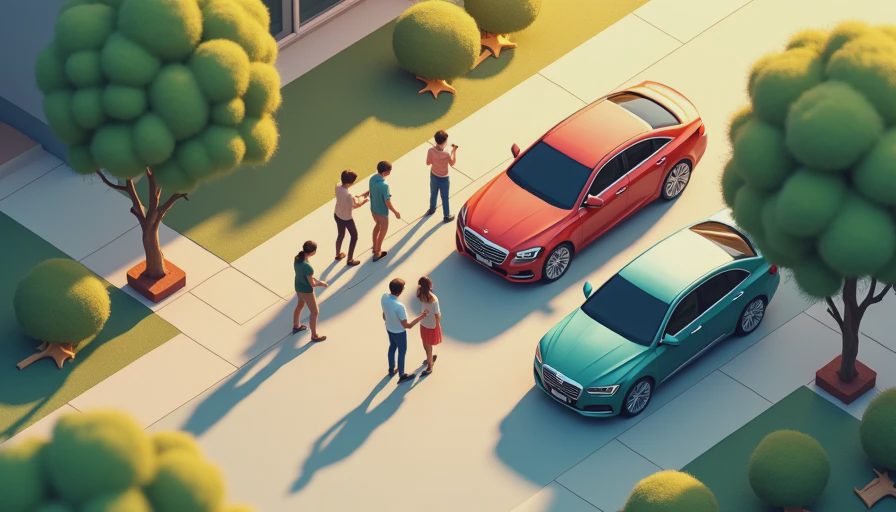
There is no universal winner, because the safest car for a commuter is not necessarily the safest car for a family towing a small trailer or carrying three child seats. Still, several mainstream vehicles deserve close attention because they combine strong safety equipment with reasonable size and availability.
The Subaru Forester has long appealed to buyers who prioritize visibility, standard all-wheel drive, and a straightforward seating position. The Honda CR-V offers a roomy cabin and broad availability, while the Toyota RAV4 gives shoppers hybrid options without requiring a move to a larger vehicle. The Mazda CX-50 brings responsive handling and a solid-feeling cabin, although buyers should compare the exact model year and standard equipment.
Sedan shoppers should not dismiss the Toyota Camry, Honda Accord, or Subaru Legacy simply because crossovers dominate showroom floors. Lower seating can improve handling and make entry less convenient for some people, but sedans generally have a lower center of gravity and can offer excellent outward visibility. The right choice depends on crash-test results for the specific year, not just the name on the trunk.
Electric vehicles add another wrinkle. A low battery pack can lower the center of gravity, and many EVs include advanced driver-assistance hardware. However, curb weight, repair complexity, tire choice, and battery-fire response are separate considerations. Do not treat “electric” as a synonym for “safe.” Compare the same evidence you would use for a gasoline vehicle.
Why size and weight still matter
A smaller car can earn excellent ratings and still face physical disadvantages in a collision with a substantially heavier vehicle. That does not make every large SUV the safest car. Large vehicles can take longer to stop, create wider blind zones, and cause more severe consequences for people outside the vehicle. Their extra mass is useful in some crashes, but it is not a substitute for good engineering.
A midsize crossover often represents a sensible compromise. It can provide more rear-seat room and cargo capacity than a compact sedan without the tall hood, heavy curb weight, and parking difficulty of a full-size SUV. For a household with a new driver, an easily controlled vehicle with strong visibility may be safer than an oversized model loaded with unfamiliar technology.
Child passengers also change the calculation. Check the location and accessibility of lower anchors, the shape of the rear seat, and whether a rear-facing seat leaves enough room for the front passenger. Install the actual car seat during a test drive. Brochure dimensions do not always reveal where the struggle will occur.
Driver assistance is useful, not autonomous
The safest car on paper can still be involved in a crash if its driver misunderstands the technology. Systems marketed as hands-free or semi-automated remain limited by lane markings, weather, sensor blockage, construction zones, and software boundaries. A driver must stay attentive and ready to steer or brake.
Before buying, test automatic emergency braking at a dealership demonstration if one is available, and learn which systems are standard rather than optional. Some entry trims include forward collision warning but not blind-spot monitoring. Others bundle the useful features into a $1,000 to $3,000 package. That difference can change the value calculation quickly.
Also examine the interface. If changing the lane-centering setting requires several screen taps, the system may be less useful in daily traffic. Physical controls for lights, wipers, and climate functions reduce distraction. Safety is partly about whether a driver can operate the vehicle without searching through menus.

Recalls, repairs, and insurance costs
A safety evaluation should include the vehicle’s recall history. Search the VIN on the NHTSA recall database before purchasing a used car, and confirm that open recalls have been repaired. A recall is not automatically evidence that a model is unsafe forever; it is a formal notice that a defect requires a remedy. The important question is whether the repair was completed.
Insurance is another practical piece of the answer to what is the safest car. Premiums reflect many factors, including location, driving record, coverage limits, repair costs, theft risk, and the vehicle’s claims history. Advanced sensors and aluminum body panels can make some crash repairs expensive even when occupants walk away safely. Get an insurance quote before signing a purchase contract, particularly for a new EV or a luxury SUV.
Collision and comprehensive coverage are usually required by a lender, while liability coverage pays for injuries or property damage a driver causes to others. A higher deductible can lower the premium, but it also means keeping more cash available after a covered claim. A safe vehicle does not eliminate the need for appropriate coverage.
A method that beats the showroom pitch
To decide what is the safest car for your household, begin with a shortlist of three to five vehicles from different brands. Check the latest IIHS and NHTSA results for each exact model year. Confirm that the tested safety features are standard on the trim you can afford. Review open recalls, inspect headlights and tire condition on used examples, and test the rear-seat configuration with your child restraints.
Then request insurance quotes using the same limits and deductibles for every candidate. Compare purchase price, fuel or charging costs, likely maintenance, and replacement-part exposure. A model that costs $40 less per month to finance can lose that advantage if insurance and tires cost substantially more.
So, what is the safest car? It is usually a well-tested vehicle with strong crash protection, effective standard crash avoidance, clear visibility, manageable size, and a driver who understands its limits. Start with independent data, inspect the exact trim, and let the numbers—not the window sticker—make the final call.

Travellers Write
No letters yet — be the first traveller to write.