A ford escape recall is not one story but a running list of safety campaigns covering different model years, factories, components, and fixes. The practical question is simple: does a specific Escape have an open recall tied to its vehicle identification number, or VIN? That answer comes from Ford or the National Highway Traffic Safety Administration, not a social-media thread or a dealer's sales pitch.
Here's what we know — and here's what we don't. Ford has sold the Escape across several generations since 2000, and a recall attached to a 2013 vehicle does not automatically apply to a 2022 model. Owners need the VIN, the campaign details, and the remedy status before deciding whether the vehicle is safe to drive or worth buying.
What a ford escape recall actually means
A recall means the automaker or NHTSA has identified a safety-related defect or a failure to meet a federal safety standard. Ford must notify affected owners and provide an available remedy at no charge through an authorized dealership. The repair could involve software, a wiring harness, a camera, a seat component, a brake-related part, or another system. The word “recall” describes the safety action, not the severity of every vehicle involved.
An open campaign is different from a technical service bulletin, or TSB. A TSB gives dealership technicians guidance for diagnosing or repairing a recurring issue, but it is not automatically a free repair for every owner. A recall repair is generally performed without charging for the necessary parts and labor, even when the vehicle is outside its original warranty period.
A notice also does not prove that every affected Escape will fail. It does mean the risk was serious enough for a formal safety response. Reading the filing matters. Some campaigns involve a crash risk, while others concern fire, loss of control, visibility, or a component that could fail under particular conditions.
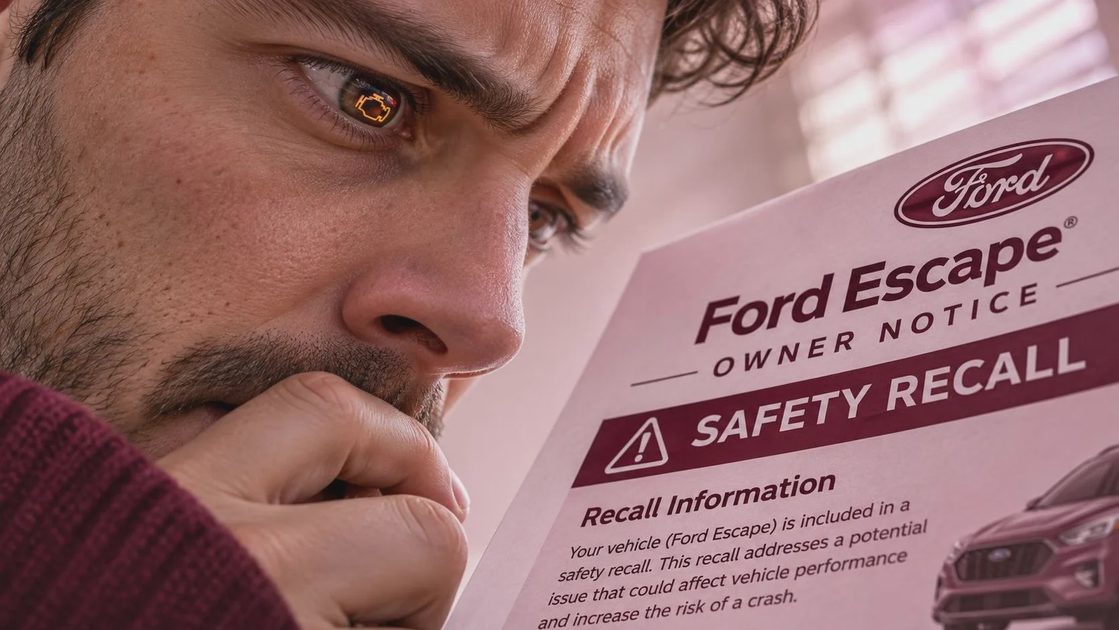
How to check a ford escape recall by VIN
Start with the 17-character VIN. It is commonly visible through the windshield on the driver's side, on the driver's door-jamb label, and on registration or insurance documents. Enter that number into Ford's recall lookup tool and the NHTSA recall search. Use both when practical: Ford can show manufacturer service information, while NHTSA maintains the federal recall record.
Search results usually identify the campaign number, affected production range, defect description, safety consequence, remedy, and whether the repair is complete. A result showing “remedy not yet available” is not the same as a completed repair. It means the owner should monitor Ford's instructions and follow any interim guidance in the notification.
If the vehicle has changed hands, update the ownership record with Ford and the state motor-vehicle agency. Recall notices often fail to reach a current owner when the automaker has an old address. A dealer service department can also check the VIN, but ask for the campaign number and repair status in writing. That small paper trail is useful when selling, financing, or disputing a missed notification.
Why model year and build date matter
A ford escape recall can cover only a narrow production window. Two Escapes with the same trim, engine, and model year may have different parts if they were built weeks apart or at different plants. That is why a broad internet search is a starting point, not a final diagnosis.
The same principle applies to powertrains. Escape versions have used gasoline engines, hybrid systems, and plug-in hybrid technology in different years. A campaign involving high-voltage components, for example, cannot be assumed to affect a conventional gasoline Escape. Conversely, a software or brake-system campaign might span several powertrain configurations.
Do not let a clean vehicle-history report settle the issue. Services such as Carfax can show reported repair events, but they are not a substitute for a current VIN lookup. A recall repair may never appear as an accident or title event. The official campaign record is the stronger source.
What owners should do after finding an open campaign
If your ford escape recall search shows an available remedy, schedule the repair with an authorized Ford dealer. Ask how long the work will take, whether parts are in stock, and whether the vehicle should be parked until completion. Follow the written notice rather than relying on a generic statement that the Escape “seems fine.” Safety defects are not always visible during a short test drive.
Keep the recall letter, appointment confirmation, repair order, and final invoice. The invoice should identify the campaign and state that the recall remedy was completed. If a dealer cannot perform the work because parts are unavailable, ask for an estimated arrival date and contact Ford customer service if the issue involves an urgent safety warning.
Owners who experience the described defect should report it to NHTSA, especially if the vehicle loses power, catches fire, rolls unexpectedly, or suffers a component failure. Include the VIN, mileage, date, symptoms, and repair history. Those reports help regulators identify patterns beyond individual dealership files.
Does a ford escape recall affect car insurance?
A ford escape recall does not automatically cancel a policy or trigger a premium increase. Auto insurance pricing is primarily based on factors such as driving history, location, vehicle characteristics, coverage limits, claims, and deductibles. A recall itself is not a traffic violation, and completing a recall repair is not normally an insurance claim.
The financial risk comes from ignoring a known defect and then having a loss. If a mechanical problem causes a crash, coverage questions can become more complicated, particularly when an owner knowingly disregards a safety warning. Collision coverage generally addresses damage to the insured vehicle after a covered crash, while liability coverage addresses injuries or property damage for which the driver is legally responsible. Neither coverage replaces a free recall repair.
Comprehensive coverage is generally for non-crash events such as theft, hail, vandalism, or certain animal strikes. It is not a substitute for a defective part being repaired by the manufacturer. Before driving an affected Escape, resolve the campaign and keep the documentation for your records.
Buying a used Escape with an open recall
An open ford escape recall should not automatically kill a used-car deal, but it should change the transaction. Get the VIN before visiting the lot, run the official searches, and ask the seller to complete every available remedy before money changes hands. A dealer may advertise a “safety inspected” vehicle while a manufacturer campaign remains open; those phrases are not interchangeable.
For a private sale, price the inconvenience and risk into the negotiation only after confirming that the repair is free and available. If parts are backordered, a $500 discount does not necessarily compensate for losing transportation or waiting weeks for service. Also check for completed campaigns, maintenance records, tire condition, brake wear, and signs of flood or collision damage.
The sensible final step is an independent inspection. A mechanic cannot close a Ford recall in the manufacturer's system, but can find unrelated problems that a recall search will never show. That is the difference between checking a database and actually evaluating the car.
The short version
Search the VIN, read the actual campaign notice, and confirm whether the remedy is available. Do not confuse a TSB with a recall, and do not treat a vehicle-history report as a substitute for an official lookup. For owners, recall repairs are generally free through Ford dealers. For buyers, an open campaign is a negotiation and scheduling issue, not a reason to guess.
The cleanest record is one that shows the campaign number, completed repair, and final service paperwork. Filed under: stories the PR team did not pitch, but every Escape owner should read before turning the key.
Travellers Write
No letters yet — be the first traveller to write.