Tesla's over-the-air software updates have been a hallmark of its vehicles for years, but the Cybertruck takes that capability into new territory. The first batch of Tesla Cybertruck OTA updates hit owners within weeks of the first deliveries, bringing everything from off-road calibration tweaks to camera view improvements. Here's what we know — and what we don't — about the software roadmap for Tesla's angular electric pickup.
What OTA Updates Have Meant for Cybertruck Owners So Far
Since the Cybertruck started rolling off the assembly line in late 2023, Tesla has pushed at least six notable OTA updates. The earliest ones focused on the vehicle's unique cornering and handling characteristics. Owners reported that a December 2023 update improved the stability of the adaptive air suspension at highway speeds. Another update in January 2024 added a "Wade Mode" for shallow water crossings, calibrating the battery pack seals and raising the ride height.
More recent Tesla Cybertruck OTA updates have addressed camera functionality. The 2024.8 update introduced a new off-road camera view that stitches together the front and side cameras to help drivers see over the steep hood. There's also a trailer backup assist feature that uses the rear-facing camera to overlay steering guidance — a direct response to early owner feedback that the Cybertruck's long wheelbase made trailer maneuvering tricky.
Beyond features, OTA updates have also fixed bugs. Tesla resolved a glitch with the tonneau cover controller in a February 2024 patch, and a March update improved the accuracy of the remaining range estimates. None of these required a dealership visit — that's the entire point.
How Tesla Cybertruck OTA Updates Work — And Why They Matter
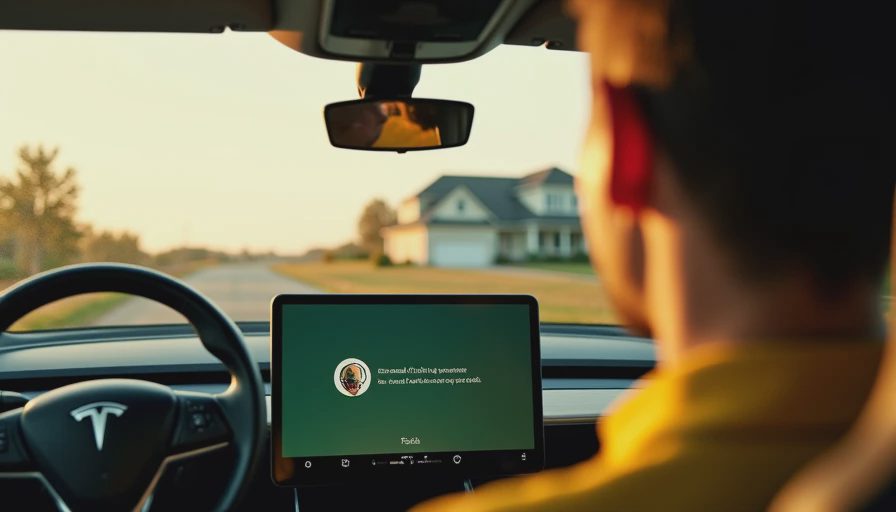
Tesla Cybertruck OTA updates work the same way they do on the Model 3 or Model Y: the vehicle connects to Tesla's servers via LTE or Wi-Fi, downloads the update package (usually 200-500 MB), and installs it while parked. Owners get a notification on the infotainment screen and can schedule the installation for a specific time — typically overnight.
What's different with the Cybertruck is the scope of systems that can be updated. The steer-by-wire system, the 48-volt architecture, and the rear-wheel steering are all software-controlled. That means a single update can alter the turning radius or change the steering feel — a capability that traditional truckmakers can't match without a physical recall. Ford and GM have dabbled with OTA for infotainment, but Tesla is the only one updating suspension tuning, drivetrain mapping, and even brake pedal feel over the air.
From a safety perspective, NHTSA has already acknowledged that software patches can serve as recall remedies. At least two Cybertruck recalls — one for a mislabeled instrument cluster warning and another for an incorrect tire pressure display — were corrected via OTA without owners ever taking the truck to a service center.

What's Next for Cybertruck OTA Updates
The biggest unknown is when Full Self-Driving (FSD) v12 will land on the Cybertruck. Tesla has been testing FSD on the platform internally, but public release has been delayed multiple times. The hardware — including the new AI4 computer — is already installed, so a future Tesla Cybertruck OTA update could unlock hands-free highway driving and eventually autonomous city streets. Elon Musk has hinted that FSD Beta for the Cybertruck could arrive before the end of the year, but that timeline has slipped before.
Other likely updates include: improved off-road driving modes (rock crawl, sand, etc.), a more granular power meter that shows how the tri-motor setup distributes torque, and possibly a software-locked range extender battery that activates when you pay a fee — a controversial model Tesla has used on other vehicles.
There's also a chance Tesla will use OTA to fix the Cybertruck's infamous panel gaps and fit-and-finish issues. No, a software update can't realign sheet metal. But it can adjust the latch closure sequence for the doors and frunk, which several owners have complained about. A few millimeters of tolerance can sometimes be compensated for with a firmware tweak.
The Bottom Line on Tesla Cybertruck OTA Updates
Tesla Cybertruck OTA updates are not just a convenience — they're a fundamental part of the vehicle's DNA. Traditional automakers treat a software update as an afterthought; Tesla treats it as the primary interface for improvement. Whether it's adding a feature that wasn't there at delivery or fixing a recall without a phone call, the Cybertruck's ability to evolve via OTA is one of its strongest selling points. Here's what we know: the updates will keep coming. Here's what we don't: exactly when FSD arrives and whether Tesla will charge for it. Either way, the truck you drive today won't be the same as the one you drive six months from now.
Frequently Asked Questions About Cybertruck OTA Updates
Can I refuse an OTA update? You can postpone it indefinitely, but Tesla strongly recommends installing within a few weeks to ensure safety and feature improvements. Eventually, the update may become mandatory for Supercharger access or warranty coverage.
Do updates cost money? So far, all feature updates and bug fixes have been free. Tesla has not announced any paid OTA upgrades for the Cybertruck, though the company has charged for features like acceleration boost on other models.
How long does installation take? Most updates take 25 to 45 minutes. During that time, the vehicle cannot be driven. Tesla recommends scheduling updates when you won't need the truck for at least an hour.
Will an update ever reduce range or performance? It's unlikely. Tesla's update history shows consistent improvements in efficiency and power delivery over time. However, some owners have reported temporary dips in range after major updates, which usually stabilize after a few charging cycles.

Travellers Write
No letters yet — be the first traveller to write.