
The honda fuel pump recall involves a potential loss of engine power or a no-start condition in certain Honda and Acura vehicles. The practical next step is to check your vehicle identification number, or VIN, through Honda’s recall lookup or the National Highway Traffic Safety Administration’s recall tool, then schedule any open repair with an authorized dealer. Not every vehicle from an affected model line is included, and the VIN result matters more than a list of model years.
What went wrong with the fuel pump
Honda has issued multiple fuel pump recalls over time. One major campaign, announced in December 2023, covered certain Honda and Acura vehicles with fuel pumps whose impellers could deform and interfere with pump operation. The fuel pump may stop working, preventing the engine from starting or causing it to stall while driving. A stall raises the risk of a crash.
That campaign expanded earlier recalls involving the same general issue. It included vehicles across several model lines and years, but inclusion depends on the individual vehicle and the relevant recall population. An Accord or CR-V badge alone is not proof that a particular vehicle needs the repair; neither is an Acura badge proof that it does not.
The remedy for the affected impeller campaign is replacement of the fuel pump assembly. An authorized dealer performs recall repairs at no charge. The recall record associated with your VIN is the place to confirm the applicable remedy, because a different fuel-system campaign can involve a different component and repair.
Here’s what we know — and here’s what we don’t: the impeller defect and its potential consequences are established, but a VIN lookup is needed to determine whether a particular vehicle has an open recall. A vehicle may also have been repaired already.
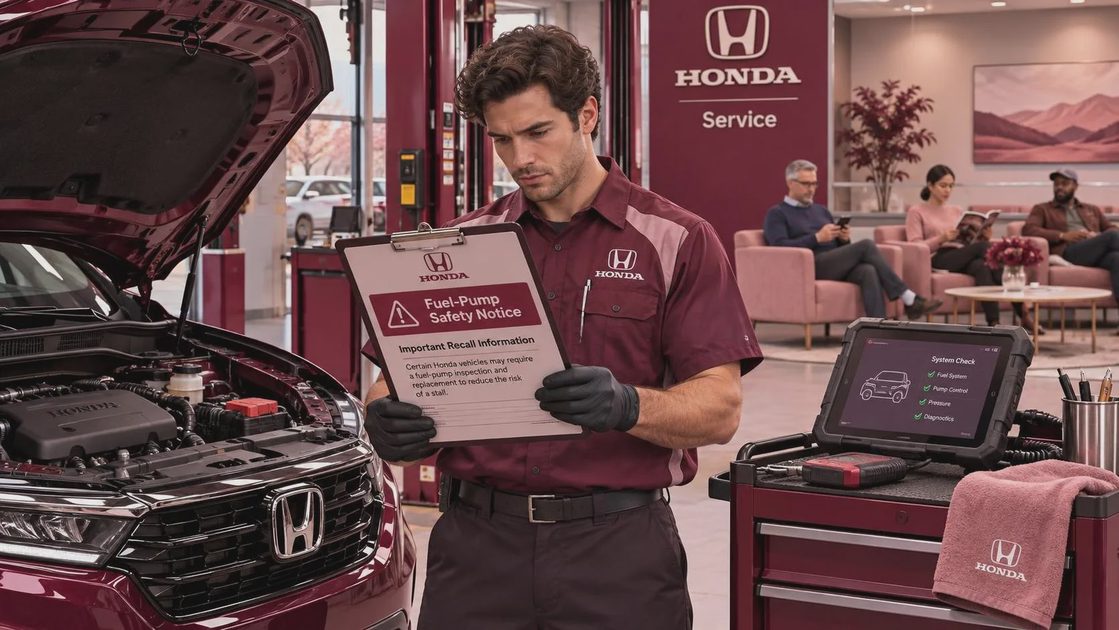
How to check the honda fuel pump recall by VIN
Find the 17-character VIN at the base of the windshield on the driver’s side, on the driver’s door jamb label, or on your registration. Enter it into Honda’s owner recall lookup or the NHTSA recall search. Acura owners can use Acura’s recall lookup as well. These tools are more useful than matching a model and year against a headline because they identify recalls associated with a specific vehicle.
Read the result closely. An open recall means the repair is still listed as incomplete; a result indicating no open recalls does not necessarily mean the vehicle was never included in one. It may have been repaired. Records can also take time to update after a repair, so keep the dealer’s invoice and ask when the work will be reported as complete.
If you bought the vehicle used, check it even if the seller said all recall work was done. A recall can be announced after a sale, and an owner notice may have gone to a previous address. Update your contact information with Honda or Acura so future notices have a better chance of reaching you.
A lookup result and a symptom are separate pieces of information. If the engine stalls or struggles to start but the VIN tool shows no open fuel pump recall, the vehicle still needs diagnosis. Don’t assume a recall will cover an unrelated repair, and don’t ignore the symptom because the search came back clear.
Scheduling a repair and dealing with parts delays
Call an authorized Honda or Acura dealer, provide the VIN, and ask whether the required parts are available before booking. Confirm which recall the appointment covers and whether the dealer needs to inspect the vehicle before ordering anything. If you have more than one open recall, ask whether the work can be combined in one visit.
Parts availability can vary by dealer and campaign. If a dealer cannot schedule the repair promptly, ask to be contacted when parts arrive and check with another authorized dealer. You can also contact Honda or Acura customer service using the number on the manufacturer’s recall page or your notice. Keep a record of the date, the dealer and what you were told.
A recall notice may explain whether an interim step is available while the permanent remedy is pending. Don’t assume every campaign has one, or that a dealer will automatically provide a loaner. Ask what transportation assistance, if any, is offered for your situation.

If you paid for a qualifying repair before a recall was announced, reimbursement may be possible. The notice should explain the process and any conditions. Gather the repair order, proof of payment and VIN, then ask the manufacturer how to submit them. A prior fuel-system bill is not automatically reimbursable; the work must meet the campaign’s requirements.
What to do if the engine stalls
The honda fuel pump recall matters because a stalled engine can leave a driver with less control and a vehicle without power in traffic. If the engine loses power, turn on the hazard lights, steer toward a safe place if you can and avoid stopping in a travel lane when possible. Steering and braking assistance can be reduced when the engine is off, so greater effort may be needed.
Once safely stopped, arrange a tow if the vehicle cannot be driven safely. Tell the dealer or roadside assistance provider about the stall and any open recall. A recall lookup cannot diagnose the cause from the roadside, and repeated starting attempts are not a substitute for an inspection.
If you smell fuel or see a leak, move away from the vehicle, avoid ignition sources and call emergency services as appropriate. A fuel odor or leak should be treated seriously, but it should not be assumed to be the impeller problem described above.
If the recall record looks wrong
Sometimes the paperwork and the database do not line up. If a completed honda fuel pump recall still appears open after the dealer has had time to report it, provide the repair invoice to the dealer and ask it to verify the VIN and update the record. If a dealer says the vehicle is ineligible but your notice says otherwise, ask for the campaign number and an explanation, then contact the manufacturer.
You can also report an unresolved safety issue to NHTSA. Include the VIN, dates, symptoms and repair history, and distinguish what the dealer diagnosed from what you suspect. For an owner, the useful finish line is straightforward: a documented repair and a recall record that reflects it.


Travellers Write
No letters yet — be the first traveller to write.